
Fresno City Directory Holdings
Fresno's historical directory shelf is a set of overlapping publications, not one perfect annual roll. The Fresno County Public Library Heritage Center is the main local starting point, with microfilm and some recent hard-copy editions. Scope matters as much as the cover. A Fresno County-wide book can include rural communities that disappear when a later Polk volume becomes Fresno City only. A criss-cross directory reverses the direction from a person's name to an address, while telephone books follow subscriber coverage. The table separates those uses so a missing listing is not mistaken for a missing person.
| Collection | Years | Where Held | Access |
|---|---|---|---|
| Fresno County and city directories | Most years, with listed gaps | Heritage Center | Microfilm; some hard copy |
| Polk-Husted and later R.L. Polk | Began 1907; countywide through 1957, then city-focused | Heritage Center directory shelf | In-library holdings check |
| Haines criss-cross directories | Began or resumed 1973 | Heritage Center | Address-to-occupant reading |
| Fresno-area telephone books | First county book 1909; city book 1946 | Heritage Center | Microfilm or hard copy as held |
| California birth and death indexes | Birth 1905-1995; death 1905-1994 | Heritage BMD collection | Library databases and microfilm |
| Fresno Bee obituaries | 1962-present; home access stated from 1985 | Heritage BMD page | Library access; card access for some years |
| School yearbooks | County and community runs vary | Heritage yearbook collection | Year-specific holdings |
| Maps and property atlases | 1891-1920 atlases; later atlas runs | Heritage maps collection | In-library and selected digital access |
| State Archives Fresno microfilm | Probate 1880-1920; deeds 1875-1900; vital runs vary | California State Archives | Catalog and reading-room research |
Known Fresno County-wide directory gaps include 1874-1880, 1885-1888, 1897, 1899, 1930, 1943, 1945-1946, and 1948. Polk-Husted, later R.L. Polk, began the familiar Fresno run in 1907. It covered all or most of Fresno County through 1957, then Fresno City only; Clovis returned to the coverage in 1973. Those shifts change what a printed directory can say about a rural Fresno household.
Fresno Library Directory Shelf
The San Joaquin Valley Heritage & Genealogy Center at the Central Library, 2420 Mariposa Street, Fresno, California 93721, is the practical place to begin. Staff can help identify a title, year, and format before a trip. The Fresno library lists the holdings through its local-history gateway and gives the phone number (559) 600-READ (7323) for collection questions. A directory may be on a microfilm reel even when a catalog record looks like a normal book. Recent issues may instead be in hard copy.
The Fresno Heritage Center directory holdings are more useful when the exact publication title and geographic scope are recorded first. Ask whether the volume is countywide, city-only, a telephone book, or a reverse directory. Note the reel or shelf information, then photograph the volume's title page and abbreviation key before copying entries.
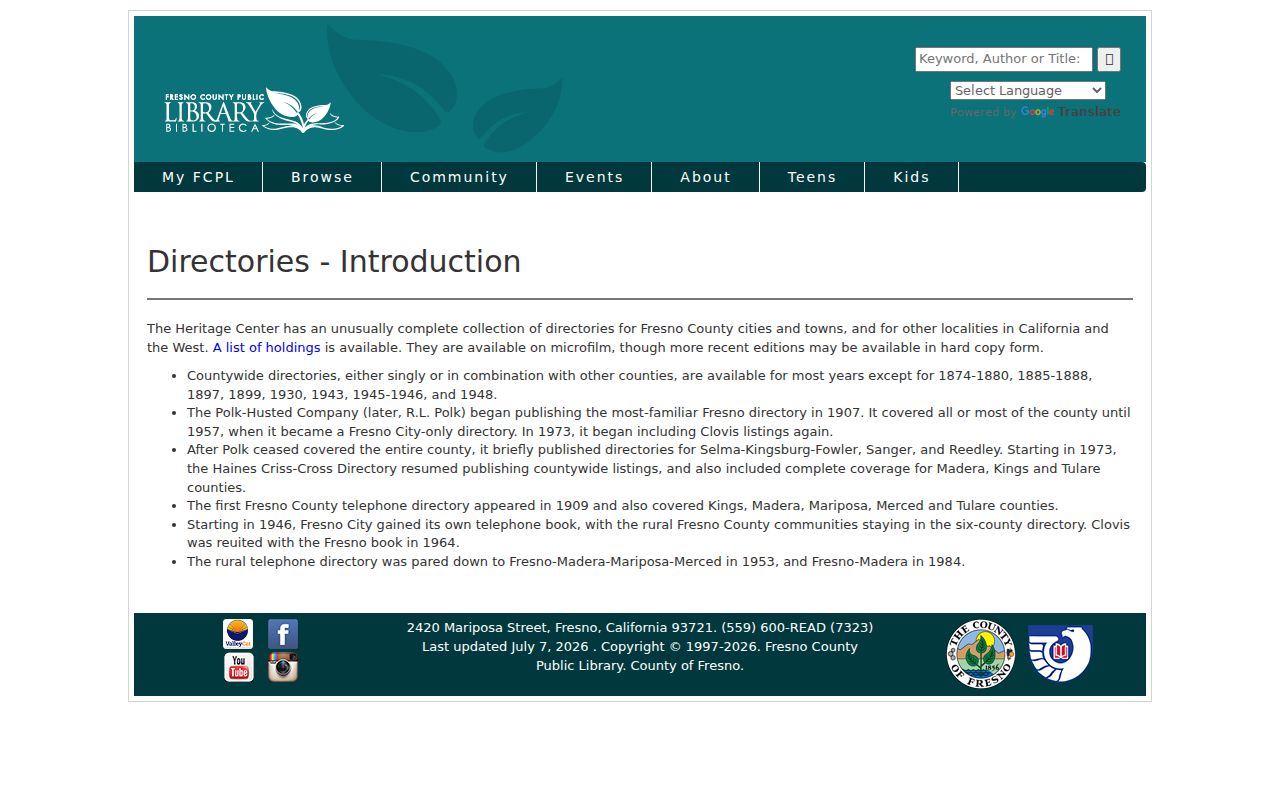
The directory-holdings image points to the Fresno library's local shelf rather than a made-up online annual run. The physical collection is the authority for which local directory years can actually be read.
Fresno State Special Collections, the Fresno City and County Historical Society, and the California State Archives add manuscript, photograph, map, and Fresno County-record context. The Internet Archive Fresno directory search is a discovery aid, not proof that a stable scan exists for every year. The California Historical Society collections add a statewide historical context layer. Catalogs and finding aids are research channels, not substitute full-text people indexes. When a Fresno library reel is not indexed by name, search the volume's alphabetical section, then use the street or classified section if it exists.
Fresno Directory Publishers and Gaps
Publisher changes explain why two adjacent Fresno volumes may not cover the same people. The Polk-Husted name later became associated with R.L. Polk, and the familiar run began in 1907. Through 1957 the coverage reached all or most of Fresno County. After that point the Fresno city-focused scope makes rural absence less meaningful. Haines began or resumed a Fresno County-wide criss-cross publication in 1973 and completely covered Madera, Kings, and Tulare counties as well. A later directory can therefore add a street view without restoring the same household universe.
- 1874-1880: a documented countywide gap, close to the period when Fresno became the county seat.
- 1885-1888: another gap that overlaps Fresno's 1885 incorporation era.
- 1897, 1899, and 1930: isolated missing years that require newspaper, census, or map checks.
- 1943, 1945-1946, and 1948: later gaps that affect wartime and postwar comparisons.
- 1973: Haines criss-cross coverage began or resumed, while Clovis returned to the Polk geographic picture.
Telephone geography adds a second layer. The first Fresno County telephone directory appeared in 1909 and also reached Kings, Madera, Mariposa, Merced, and Tulare counties. Fresno City received its own book in 1946. Clovis reunited with Fresno in 1964, while the rural footprint shifted to Fresno-Madera-Mariposa-Merced in 1953 and Fresno-Madera in 1984. Subscriber status also matters: a telephone book omits unlisted households.
Note: A gap in a Fresno directory can reflect publication scope, a missing issue, or an unlisted household, not proof that a resident moved.
Reading Fresno City Directory Entries
A Fresno directory entry is a compact clue set. An alphabetical listing may show a surname, given name or initial, spouse notation, occupation, business connection, and home address. Some editions mark a householder with h, a resident or roomer with r, a boarder with bds, or a widow with wid. These marks vary by edition. The volume's own key controls, so an abbreviation should be copied before it is interpreted.
| Name | Surname and given name or initial, with spelling preserved as printed. |
|---|---|
| Household clue | Spouse in parentheses, a widow notation, or another relationship mark where supplied. |
| Occupation | Work or business affiliation, useful for separating two people with the same name. |
| Address | House number and street, sometimes with a room, board, or residence abbreviation. |
| Owner or renter mark | A symbol or letter used by some runs; verify it in that volume's key. |
- Criss-cross directory
- An address-first directory that moves from street and number to an occupant or telephone subscriber.
- Householder index
- A name-led portion that generally lists the primary household contact, not every person at the address.
- Abbreviation key
- The volume's guide to short marks such as
h,r,bds, andwid. - Index versus proof
- A listing is a dated lead. It does not by itself prove title, kinship, or a complete household.
No literal named resident should be invented from a blank sample. Use the exact printed form from a real Fresno volume, preserve initials and both surnames, and cite the year and page in research notes.
Fresno Criss-Cross Address Reading
Haines changes the question from “Where did this name live?” to “Who was listed at this street address?” Begin with the street name, number, and any unit or directional. Read the line as an occupant or subscriber clue, then check the alphabetical name section when the volume supplies one. Compare the same address across adjacent years. A new listing may represent a move, a changed surname, a new subscriber, or a different geographic scope.
Address-first reading is especially useful after 1973, when Haines supplied a Fresno Countywide criss-cross layer that also extended across neighboring counties. It can bridge a name that changed form or a household that disappeared from the alphabetical pages. It cannot identify unlisted households, and a directory address is not the same thing as a recorded legal description.
For current parcel work, the historical address clue can be handed to the Fresno street directory workflow. That separate route uses Fresno city GIS, the APN, assessor data, and the Recorder deed index rather than treating an old criss-cross line as current proof.
Fresno Household Trail by Directory
Household tracing works best as a year-by-year ledger. Record the name exactly, then add the address, spouse notation, occupation, and any symbol from the same page. A first appearance is a lead, not a birth date. A last appearance can mean death, a move, a missed canvass, an unlisted telephone, or a change in the book's geographic reach. Fresno's listed gap years make a one-year disappearance especially weak evidence.
- Choose a confirmed person and a starting year. Search the alphabetical section and copy the name, initials, spouse clue, occupation, and full address.
- Check the same surname and address for adult relatives, a widow notation, or a second household contact. Keep each clue separate from an assumption.
- Move forward one available volume at a time. Mark every address and occupation change, including a shift between Fresno city-only and Fresno Countywide coverage.
- After 1973, read the Haines address section for the former address. Use it to find an occupant or subscriber, not to assert a complete household.
- Pair the directory trail with census, vital, obituary, deed, or court evidence when a relationship or life event matters.
The process is strongest when one fact is anchored twice. A directory can place a person near a street, a census can add household relationship and birthplace, and a deed can identify an owner through a legal description. If the sources disagree, preserve both versions and investigate the date, scope, and spelling before choosing one.
Fresno Census and Directory Pairing
The federal census fills a different gap from a printed Fresno volume. The 1950 census is the latest named decennial census currently public under the 72-year rule, and it can add age, birthplace, household relationship, and enumeration-route context. A directory often gives a sharper street address and occupation, while the census may group relatives who never appear in the householder listing. Use the two records as parallel views, not as interchangeable rolls.
The 1950 Census search at the National Archives works best after a likely name, neighborhood, and period have been identified. Enumeration districts and street indexes help when a surname was mistranscribed. For Fresno's multilingual communities, search both surnames, initials, married and maiden forms, and alternate Armenian or Spanish spellings. A match should also fit the address, age, relationship, or occupation.
When a directory volume and census year do not line up, check the nearest available volume rather than forcing a false annual sequence. The directory may have a gap, the census may place a family on a rural route, or the physical address may have changed with annexation or street development.
Fresno Gap Sources for Directories
Fresno's Heritage Center companion collections help explain a missing name. Vital indexes supply likely birth, death, marriage, or divorce dates. The Fresno Bee obituary collection can add relatives and a last address, while yearbooks can reconnect a classmate or faculty member when the directory is silent. None of these is a replacement for the missing volume, but each can narrow the next year, spelling, or household to check.
The Fresno Heritage Center birth, marriage, death, and obituary collection brings those sources together.
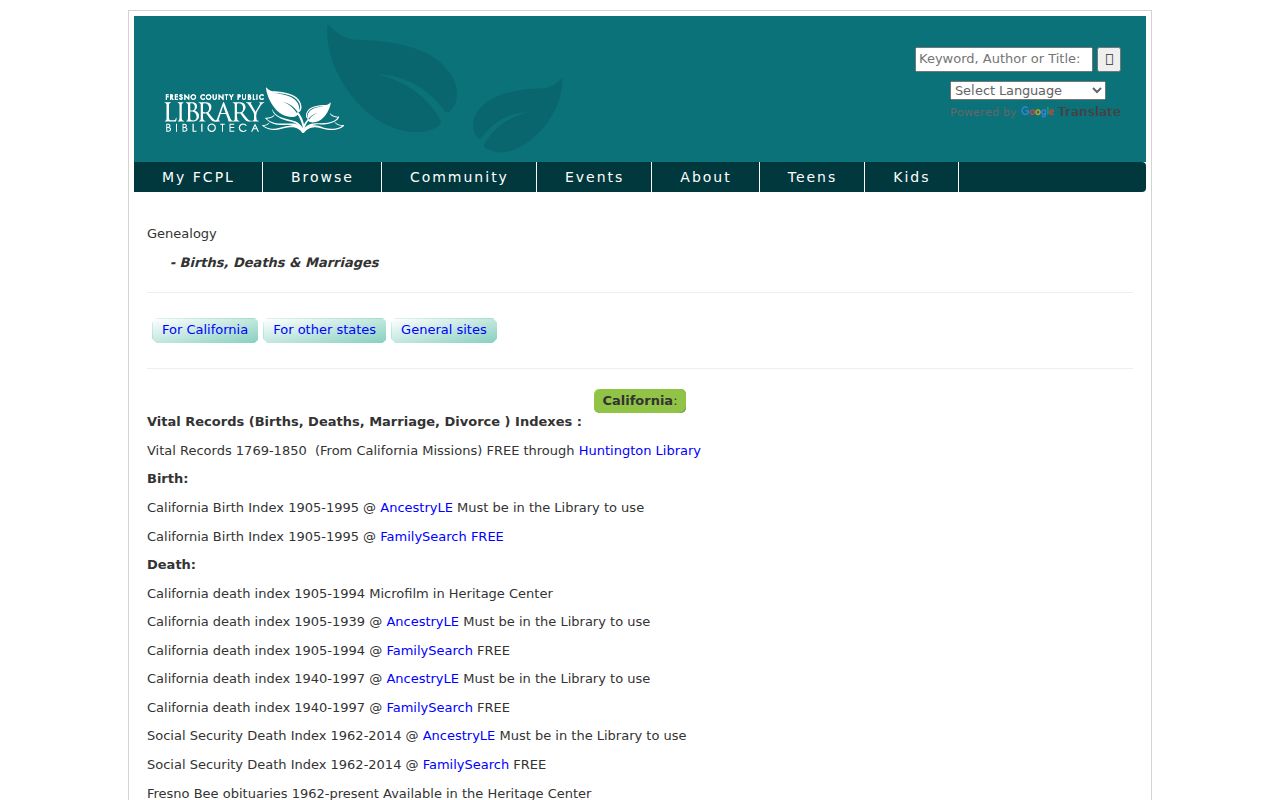
The vital-index image represents a companion search, not a literal directory entry. An index fact still needs the correct Fresno or California custodian when a certified copy is required.
The library's Fresno yearbook holdings add school, club, faculty, and class connections.
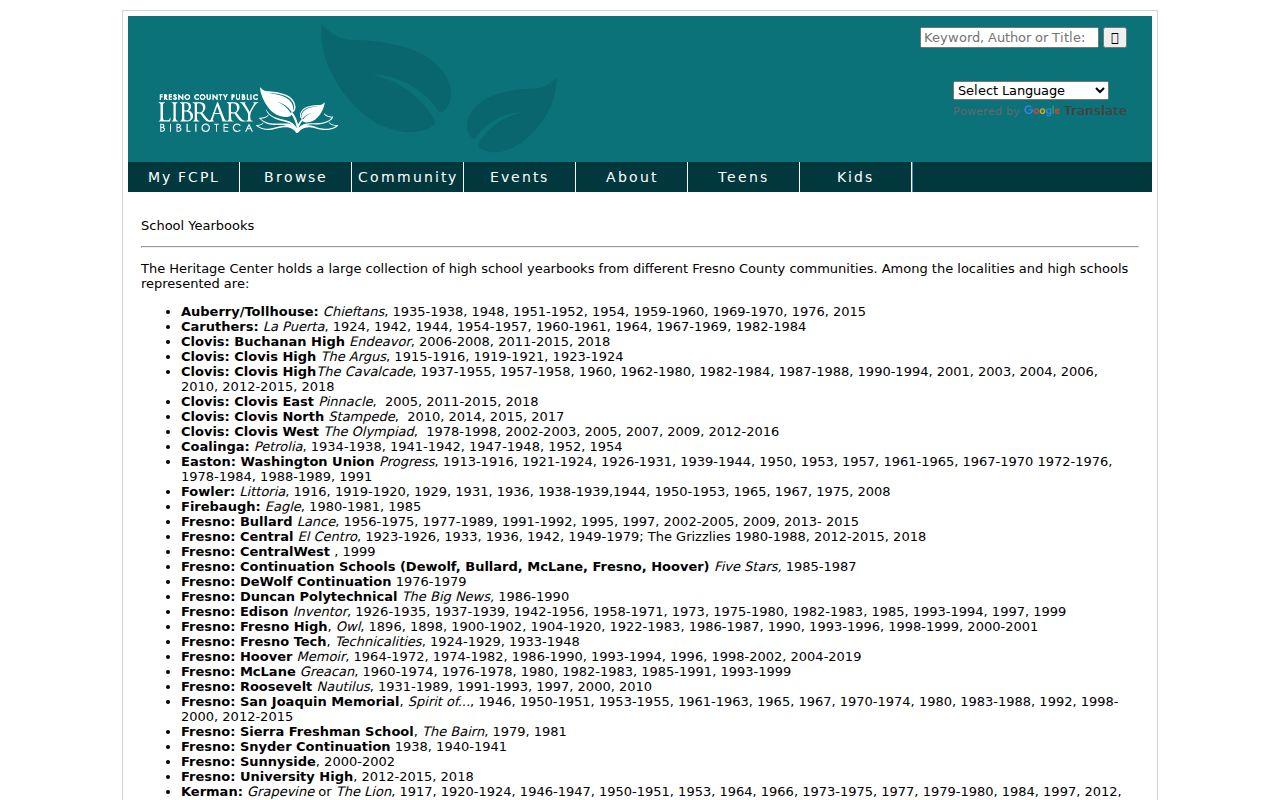
Yearbook context can distinguish two people with the same name, but a school appearance does not establish a present address or a family relationship.
Fresno Maps for Old Directories
Maps keep an old directory address tied to a place. The Heritage Center lists the Official Historical Atlas of Fresno County from 1891, the Harvey atlas from 1907, Guard atlases from 1909, 1911, and 1913, Progressive atlases from about 1920 and 1935, the Real Estate Atlas from 1966-1981, and California Agri-Land county volumes from 1978-2007. The collection also points to Fresno County Sanborn maps.
The Fresno historical maps and atlases collection supplies the place-based context for a directory address.
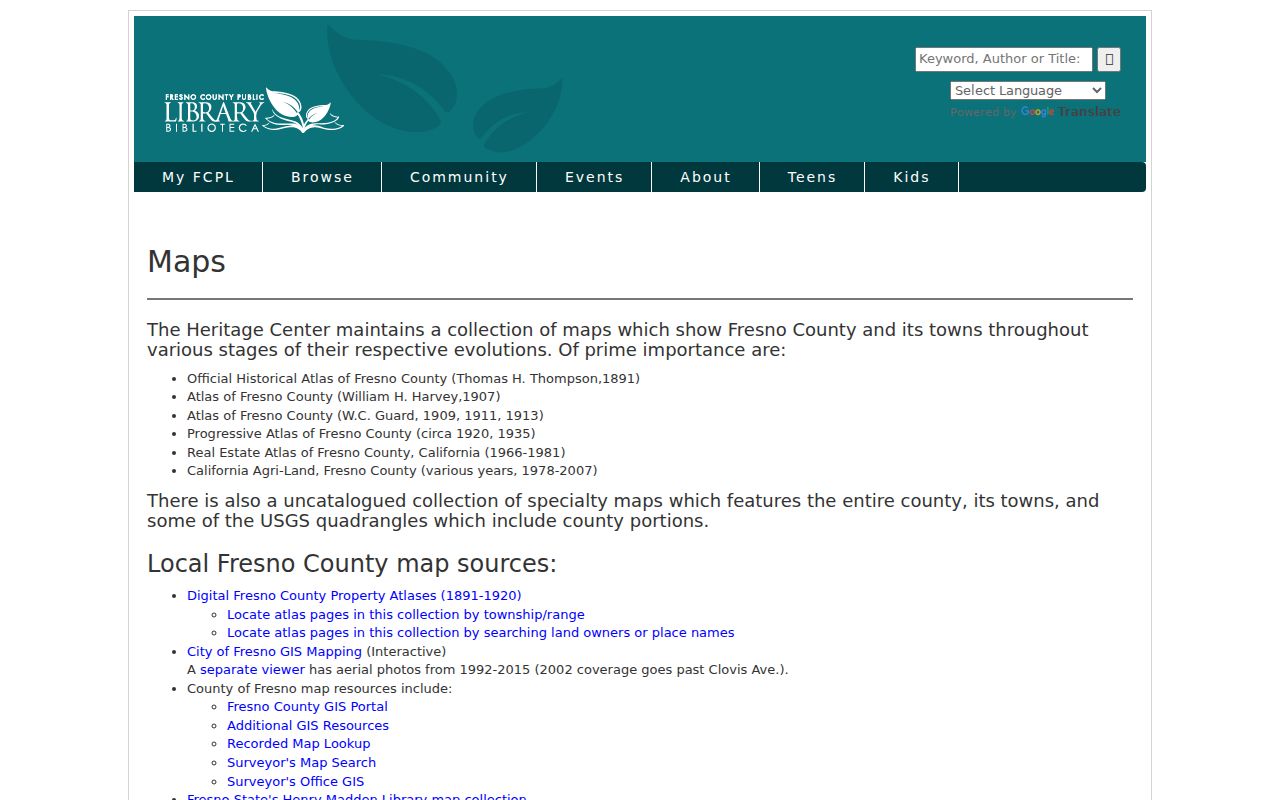
Atlas and Sanborn sheets can show a tract, building footprint, landowner label, or former street context. They do not prove who occupied a structure. Pair the map with a directory, census, deed, or permit record.
Fresno annexations, rural-route changes, freeway work, and redevelopment can make a modern address look unrelated to an older listing. Carry the lot, block, subdivision, or nearby names across the map. A legal description or APN is stronger continuity evidence than a modern postal label.
Fresno History Behind Directories
Fresno's record history explains why the shelf changes over time. Fresno County was created in 1856, the county seat moved from Millerton to the railroad town of Fresno in 1874, and the city incorporated in 1885. The railroad reached the area in 1872. An early reference to Fresno may mean the city, a rural route, or the broader county, so a directory has to be read against the date and jurisdiction.
The Fresno Heritage California history collection connects directories with newspapers, maps, vertical files, and broader discovery resources.
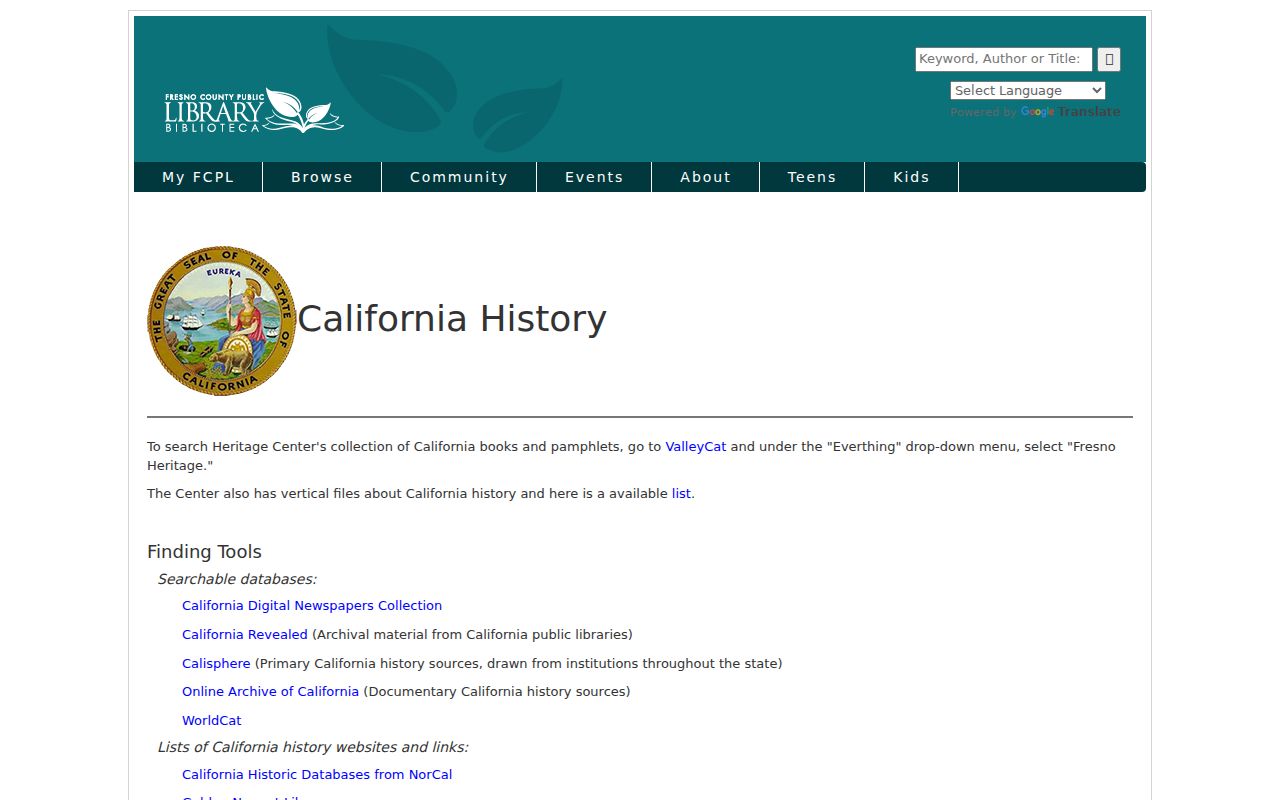
That history image points toward the local and state repositories that fill gaps between printed volumes. The California State Archives Fresno holdings include probate 1880-1920, naturalization 1856-1934, deeds 1875-1900, births 1873-1950, deaths 1878-1950, and marriages 1856-1919, although some groups may lack name indexes.
Use the Fresno volume as a dated snapshot. Compare its scope, abbreviation key, and address with the next reliable record. That habit preserves useful detail without turning a brief listing into a claim about every resident of a home.
Note: A Fresno directory entry is strongest when its year, page, geographic scope, and companion source are saved together.